Does Xero back up your data? Yes, but not for you
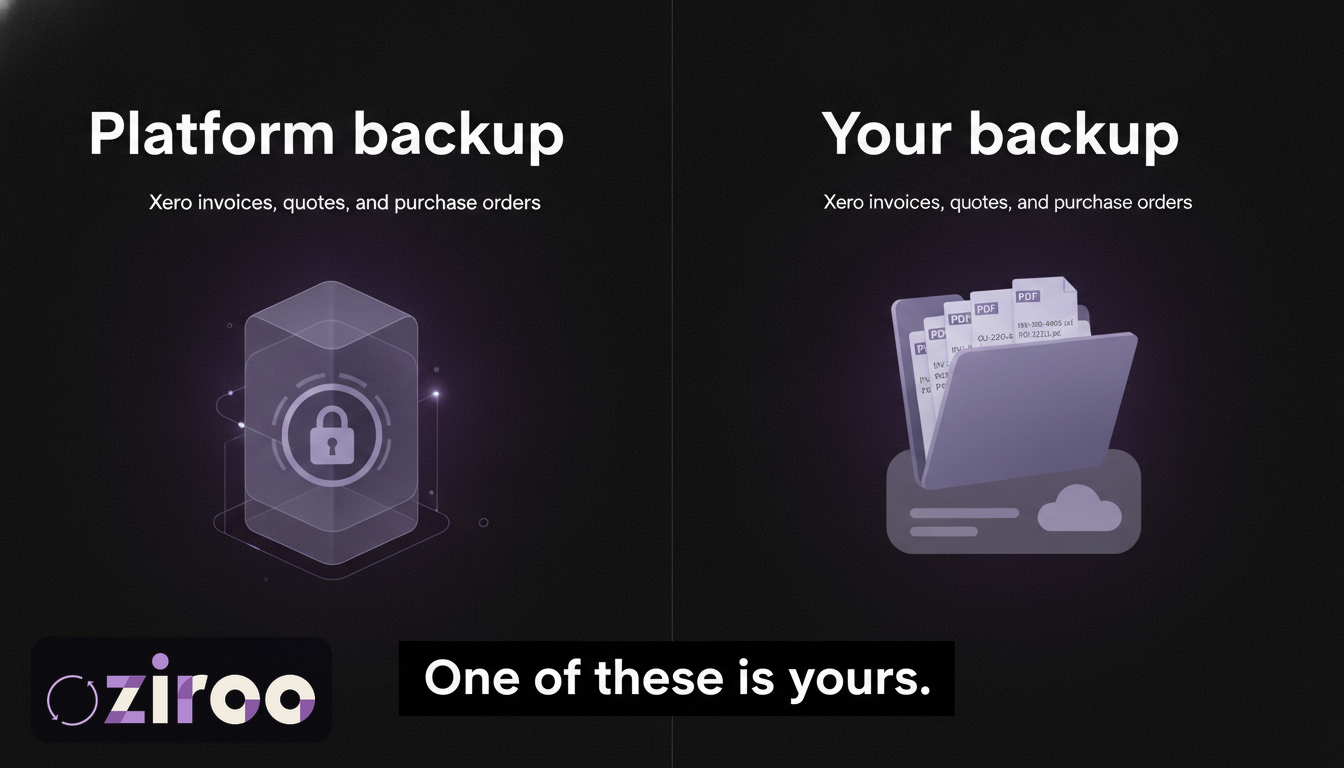
Short answer: yes, Xero backs up its systems. Xero replicates data between data centres, encrypts it, and maintains internal backups it can attempt recovery from. But that backup exists to keep the platform running, and you can't browse it, restore from it, read it during an outage, or keep it after you cancel. If you want a backup that serves you, Xero's own terms of use say you need to make it yourself.
Both halves of that answer are true at the same time, and the gap between them is where small businesses get caught. Let's take them apart.
"Backed up" means two different things
When an engineer at Xero says the platform is backed up, they mean the infrastructure can survive a disaster. A data centre floods, hardware dies, something goes badly wrong in a deployment: the platform comes back, because copies exist somewhere else. That's platform resilience, and Xero appears to do it properly.
When a business owner says "my accounts are backed up," they usually mean something else entirely: if anything goes wrong, I can get my records. Wrong things include an outage on BAS day, an accidentally deleted organisation, a lapsed subscription, or a Xero login that simply stops working. Platform resilience answers none of those.
One backup protects the platform. The other protects you. Xero provides the first and, in writing, assigns you the second.
What Xero does protect
Credit where due. Xero's data protection page describes encrypted data replicated between data centres in different locations so it stays available. Its terms of use refer to recovering lost data "from our available backups," so internal backups exist and Xero commits to reasonable recovery attempts. By cloud accounting standards, this is serious, professionally run infrastructure.
What it isn't, anywhere in the product, is a backup you can touch. There's no button that downloads your archive, no point-in-time restore for your organisation, and no scheduled export you can switch on.
Four things Xero's backup won't do for you
1. Let you restore anything yourself. If data goes missing or gets mangled, you can't reach into Xero's backups and pull it out. Recovery is a support conversation, and the contractual promise behind it is "taking reasonable steps to try and recover that data" (section 55 of the Australian terms). Reasonable steps is a real commitment. It is not a guarantee.
2. Help you during an outage. Xero's backups keep Xero recoverable, not reachable. While the platform is down, your invoices are exactly as inaccessible as if no backup existed. Section 36 of the terms is upfront that access can fail "for any number of reasons, at any time."
3. Survive your cancellation. Under section 52, once a subscription ends your data is archived and "no longer available to you." You can reactivate by paying again. Meanwhile the ATO still expects you to produce records for at least five years, subscription or no subscription.
4. Compensate you if it fails. We covered this fully in what Xero's terms say about data loss: liability for lost data is capped at your last 12 months of subscription fees, and "legal, tax or accounting compliance issues" sit on the excluded list. The backup Xero keeps comes with a best-efforts promise and a liability cap, nothing resembling insurance.
The one-question test
If your Xero login stopped working today, could you open yesterday's invoices?
If yes, you have a backup. If no, you have a subscription, and a subscription is not a record-keeping strategy. This is the test Xero's own terms are nudging you toward when section 37 tells you to maintain copies of your data.
What a backup that serves you looks like
The requirements are short: the documents themselves (PDFs as issued, not just data rows), in storage you control, kept current, readable without any platform login. We've broken down why each requirement matters and every manual way to export invoices out of Xero. The manual routes work; they're also chores that depend on someone remembering to do them.
Ziroo is the automatic version. Every morning it delivers the invoices, quotes, and purchase orders created or updated in the last 24 hours as individual PDFs plus a CSV manifest, to your inbox and to your own Dropbox, Google Drive, or OneDrive. Read-only connection, and the archive passes the one-question test by design: no Xero seat, no Ziroo login, just files in your storage.
Ziroo is in early access. Add me to the waiting list and you'll get access as spots open.
Two backups, one of them yours
Xero's backup does its job well. The job just isn't yours. Keep the copy that answers to you, and the next outage, cancellation notice, or audit letter becomes an inconvenience instead of a crisis.
Add me to the waiting list and your copy starts arriving tomorrow morning.
References to Xero's terms of use are to the Australian edition, last updated 11 February 2025, viewed July 2026. This article is general information, not legal advice. Ziroo is an independent archive service and is not affiliated with, endorsed by, or sponsored by Xero Limited.
Frequently asked questions
Does Xero automatically back up your data?
Xero maintains internal backups and replicates data across data centres for its own platform recovery. There is no customer-accessible backup: no restore button, no downloadable archive, and no scheduled export. Xero's backup policy protects the platform rather than giving subscribers an archive, and under the terms of use, maintaining copies of your data is your responsibility.
Can I restore deleted data in Xero?
Not through any self-service restore. Some records remain visible after deletion (voided and deleted invoices keep their status in the system, and archived contacts can be restored), but there is no way for a customer to roll an organisation back to an earlier point in time. Anything beyond that is a support request covered by Xero's best-efforts recovery commitment.
What happens to Xero's backups of my data when I cancel?
Section 52 of Xero's terms states that after termination your data is archived and no longer available to you, though you can reactivate the subscription to regain access. Your ATO obligation to keep records for at least five years continues either way, which is why copies in your own storage matter before you cancel, not after.
How do I back up my Xero data myself?
Three options: export manually (Xero offers per-invoice PDFs, a merged batch PDF, and CSV data exports), build a script against the Xero API, or use an automated service. Ziroo does it daily: individual PDFs of invoices, quotes, and purchase orders plus a CSV manifest, delivered to your inbox and your own cloud storage.
Prefer an automatic daily archive?
Ziroo delivers invoices, quotes, and purchase orders as PDFs plus a CSV manifest to your inbox and cloud storage every morning.
Ziroo is an independent archive service and is not affiliated with, endorsed by, or sponsored by Xero Limited.