When a client leaves: the bookkeeper's records guide
The email arrives eleven months after the disengagement letter. The client's new accountant, polite and slightly harried: "We're missing the supporting documents for several 2024 transactions. Could you send through what you have?"
You did that work. You reconciled those transactions, filed those documents, answered those queries. And you have nothing to send, because when the engagement ended, so did your access to the client's Xero organisation. The books you kept for three years are now behind a login that no longer includes you.
Nobody did anything wrong here, which is exactly the problem. This is the default outcome of a standard offboarding, and it will keep happening until offboarding includes a records step. This guide is that step: what to capture before access ends, and how the practices that never sweat this have set themselves up.
Why your access dies (and why the questions don't)
Under Xero's terms of use, the subscriber controls a subscription absolutely. Section 9 puts it directly: the subscriber decides who's invited, what access they hold, and can "change or stop that access at any time." If the client is the subscriber, your seat exists at their pleasure. If you're the subscriber on the client's behalf under the partner program, offboarding means transferring the subscription across, after which the same clause applies to the new owner.
Either way, disengagement ends your access as a matter of contract. What it doesn't end:
- Questions from successors. New accountants and bookkeepers inherit gaps, and they email backwards.
- Your professional obligations. The Tax Practitioners Board and the professional bodies expect practitioners to retain records of the work they performed, typically for at least five years. Those are records of your work, and "my access was revoked" is an awkward substitute for having them.
- Disputes. Fee disagreements, engagement scope arguments, and the occasional complaint all get decided on documentation. The party with the records has the better afternoon.
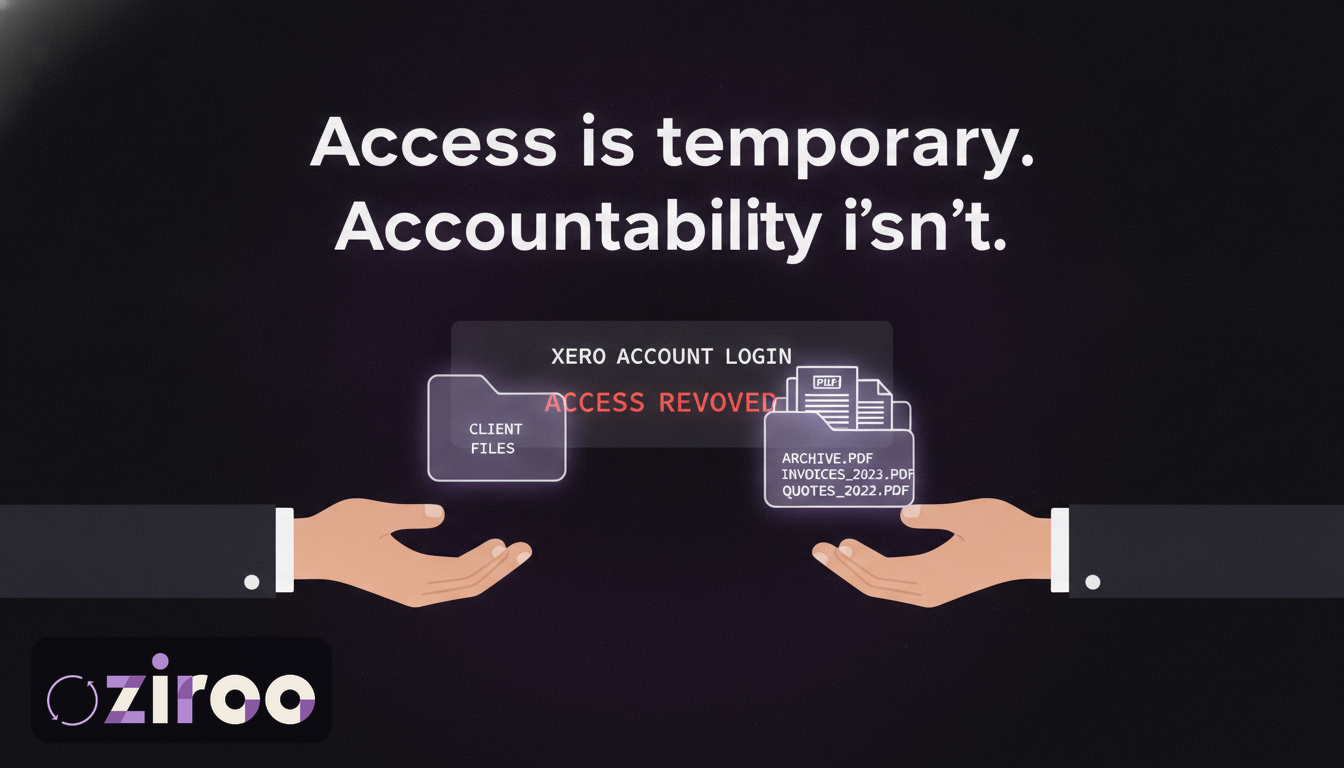
Access is temporary. Accountability isn't. The gap between the two is what this checklist closes.
Three ways clients leave, one failure mode
The orderly handover. The client moves to another practice, everyone behaves professionally, the subscription transfers cleanly. Even here, your practice's copy of the work usually doesn't survive unless someone deliberately makes one before the transfer.
The in-house move. The client takes bookkeeping internal, thanks you warmly, and removes your access the following Tuesday. The relationship stays good; your records access still hits zero.
The dark exit. Fee dispute, radio silence, or a business that folds without telling anyone. Access is revoked mid-conversation, sometimes before final invoices are paid, and anything you didn't already hold is gone from your reach precisely when a dispute makes documentation matter most.
Different politeness levels, identical records outcome. Plan for the third scenario and the first two are covered for free.
The offboarding records checklist
Run this between "we've agreed to part ways" and "access removed." A fortnight is comfortable; a day is possible.
- Export the final reports. Profit and loss, balance sheet, general ledger, and trial balance for each financial year of your engagement. These freeze the state of the books as you left them, which is the fact most likely to be questioned later.
- Pull the transaction data. Sales and purchases CSVs across the engagement period. The full export map is here if you need the less-obvious corners.
- Capture the documents that evidence your work. Invoices and bills for any period you reconciled or prepared BAS from. At engagement scale this is the merged batch PDF or an existing archive; the manual routes are documented here.
- Note the reconciliation state. A short memo: what was reconciled to when, known issues, anything handed over incomplete. Two paragraphs now beats two hours of reconstruction under dispute.
- Transfer the subscription properly. If your practice is the subscriber, hand it to the client or their new advisor per the terms, and get the transfer confirmed in writing. Never leave a departed client's subscription billing to your practice.
- Write the handover letter. List what was provided, to whom, and when. File it with the archive.
- File everything in the practice archive, per client, retained on the same clock as your working papers.
Then remove your own access if the client hasn't already, and close the file knowing it can actually be reopened.
The version where offboarding is a non-event
The checklist works. It's also seven steps of manual effort at the exact moment a relationship is ending, which is why the better practices have stopped relying on it.
Their setup: a standing archive per client, built daily while the engagement runs. Ziroo does this over a read-only connection per Xero organisation, delivering each morning's invoices, quotes, and purchase orders as individual PDFs plus a CSV manifest into storage the practice (or the client) controls. When a client leaves, the archive is simply already there, current to the final morning, and nothing about the disengagement can touch it.
The same standing archive de-risks live engagements too: if access is ever revoked mid-dispute, your documentation of the work already exists outside the disputed login.
Ziroo's Archive plan covers 3 organisations and Vault covers 10; pricing is public. Ziroo is in early access, and multi-org practices are exactly who the Vault tier was built for. Add me to the waiting list and every current client's archive starts building tomorrow.
Who should own the archive: you or the client?
Both, ideally, because you're carrying different obligations:
- The client's archive answers their record-keeping duties (the ATO's five years, the Corporations Act's seven). Best delivered to storage the client owns, so it survives you, Xero, and everyone else.
- The practice's archive answers your professional obligations: evidence of work performed, positions taken, and the state of the books at handover. It belongs in practice-controlled storage, per client, with your working papers.
One daily delivery can serve either side, and nothing prevents both existing. What fails is the shared assumption that the other party is keeping it.
Put it in the engagement letter
The cleanest time to establish the archive is before there's anything to argue about. One clause in the engagement letter does it, along the lines of: "During the engagement, the practice will maintain copies of financial documents and reports relevant to the services provided, retained in accordance with our professional obligations. On disengagement, the practice retains these records of work performed; a copy of the client archive can be provided or delivered to client-controlled storage on request."
Adapt the wording with whoever reviews your letters. The point is that a documented, expected archive is a professional practice; an undocumented pile of exports assembled during a fee dispute looks like something else. Say it upfront, do it daily, and offboarding inherits a records position instead of negotiating one.
Close the file so it can be reopened
Every engagement ends eventually. The practices that handle it well aren't luckier with clients; they just never let the records depend on a login someone else controls. Run the checklist for the client leaving this month, and set up the standing archive for everyone who hasn't yet.
Add me to the waiting list and disengagement goes back to being paperwork instead of archaeology.
References to Xero's terms of use are to the Australian edition, last updated 11 February 2025, viewed July 2026. This article is general information, not professional advice; confirm retention obligations with your professional body. Ziroo is an independent archive service and is not affiliated with, endorsed by, or sponsored by Xero Limited.
Frequently asked questions
What happens to my Xero access when a client leaves?
The subscriber controls all access under Xero's terms, so when the engagement ends your invited-user access can be removed at any time, immediately and without notice. If your practice holds the subscription for the client, offboarding involves transferring it, after which the new subscriber controls access. Any records you need must be captured before that point.
How long should a bookkeeper keep client records?
Records of work performed are typically retained for at least five years, consistent with Tax Practitioners Board expectations and ATO retention periods, and many practices align to seven years to match company and employee record rules. Confirm the specifics with your professional body, and apply the period from engagement end, not from when the work was done.
Can I keep copies of client data after disengagement?
Records of the work you performed, yes; that's what professional retention obligations expect, handled under the confidentiality and privacy duties that already bind you. The cleanest position is an archive assembled during the engagement with the client's knowledge, referenced in your engagement letter, rather than a scramble of exports on the way out.
Prefer an automatic daily archive?
Ziroo delivers invoices, quotes, and purchase orders as PDFs plus a CSV manifest to your inbox and cloud storage every morning.
Ziroo is an independent archive service and is not affiliated with, endorsed by, or sponsored by Xero Limited.